Listen:
Download: History of Israel: Part 10 – 1970’s Darkness and Light

Listen:
Download: History of Israel: Part 10 – 1970’s Darkness and Light
Comments Off on History of Israel: Part 10 – 1970’s Darkness and Light
Posted in Audio Lectures and Shiurim, Current Events, Jewish History, Machshava/Jewish Thought
Tagged Audio, Jewish History, Machshava/Jewish Thought, MP3
 The ritual is as familiar as preparing your taxes, and about as tedious. An American president leaves office and Israel is asked to make territorial concessions in one “final” attempt to make peace; a new American president takes office and Israel is asked to make territorial concessions in order to jump-start his peace efforts; Israel prevails militarily in a conflict and is asked to make territorial concessions as a “good-will gesture” to the vanquished; a new Israeli government comes to power is asked to make territorial concessions to show its good faith.
“Land for peace” and its corollary, the creation of an independent Palestinian state, remain the rage in diplomatic salons across the globe, and among the media elites. Newsweek (January 12) proclaims that “there are no other options than a comprehensive agreement that creates two sovereign states, Israel and Palestine” and that land for peace is “the only option.”
Muammar Khaddafi, on temporary furlough from the clinic and therefore given access to The New York Times Op-Ed page (January 22), helpfully suggests a “One-State Solution” to the Middle East conflict – the creation of an “Israstine” that would enable Jews and Arabs to live in peace for all eternity.
Not to be outdone, Times columnist Thomas Friedman, whose consistent wrong-headedness on Mideast policy is as ignored as his own genius is self-celebrated, proposed a “Five State Solution” (January 27), most likely because his prior advocacy of the two-state solution predictably led to the devastation of Israeli security and the horrific loss of Israeli life.
The peace-processors are at it again, seemingly oblivious to Einstein’s famous definition of insanity as “doing the same thing over and over again and expecting different results.” Land for peace has never worked, and there is not a shred of credible evidence that it will work this time or in this generation.
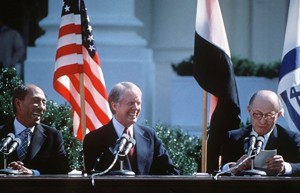
The much-heralded example – the Egyptian-Israeli peace treaty – actually proves the inefficacy of the arrangement. It created an “absence of war” that is arguably tenuous, and that allows Egypt to join the Hamas proxy war against Israel while trumpeting both its treaty and its “dismay” at the smuggling of arms and weapons to which it turns a blind eye. The 1979 agreement was less “land for peace” than it was the “return to the enemy of the bases from which they launched their aggression in exchange for their promise not to do it again” – admittedly a less catchy title than “land for peace” but certainly more accurate.
So why do ostensibly intelligent people keep repeating the same mantra? “Like a dog that returns to its vomit, so is the fool who returns to his foolishness” (Proverbs 26:11). Land for peace, a policy designed just for the Middle East, has left Israel with a porous southern border, a volatile northern border, and the creation of an irredentist terrorist apparatus in its heartland. And it is bitterly ironic that on Israeli’s quietest border – with Syria, where land for peace has not been practiced – there the peace-processors are pushing a territorial surrender that will leave the Galilee vulnerable as it has not been for more than 40 years. So why continue down this treacherous road, that, sad to say, a government headed by Benjamin Netanyahu seems destined to traverse? Why are the world’s diplomats wedded to this scheme?
There is certainly a dearth of innovative thinking, but, more important, there is an absolute rejection of any alternative – a rejection fueled by an utter denial of reality. Even a cursory review of the events of the past 20 years (even more so, the last ten) reveals that Palestinians would rather kill Jewish children than allow theirs to live; Palestinians would rather disrupt Israeli society (and many others around the world) than establish a healthy one of their own; Palestinians would rather increase the number of Jewish wounded than heal their own infirm and destroy Jewish homes rather than build their own; and Palestinians would rather rocket Israeli farms than plant their own fields.
This is reality, and we continue to ignore it at our peril. But is there an Israeli politician with the courage to concede publicly that the Arabs have not abandoned their dream of destroying Israel? Is there an Arab leader who speaks openly and unabashedly about peace and co-existence with a Jewish state, as a desideratum and not as a painful concession?
No, and the common excuse is that no Arab politician could say that and live, as the “Arab street” would not accept it. But if that is the case, then why the pretense of land for peace? Why embark on or persist in a process destined to fail because one side has failed to prepare its people for peace, or because, better said, most Arabs still perceive a Jewish state as a bone in the throat of Islamic hegemony across the Middle East? Peace is not possible if the “Arab street” is intolerant of a Jewish nation in the land of Israel.
But the very notion of deferring to the Arab street is both self-serving and comical. The Arab states are composed of dictatorships and autocracies. It strains credulity that the so-called Arab street is anything but a tool used by Arab governments to avoid difficult decisions that would foster coexistence with Israel. It is a myth behind which those feudal leaders hide in order to mask their ongoing opposition to Israel’s existence and their contempt for the very notion of Jewish statehood.
It is a charade too many Israeli leaders have tolerated for too long – one that has enabled a Hosni Mubarak to refuse to ever visit Israel for talks (all Israelis must traipse to Egypt like mendicants to gain an audience with him), that condones the refusal of Saudi leaders to shake hands or talk to an Israeli Jew, and that perceives civil and cordial contact as a major concession on their part.
We are “fools returning to our folly” if we encourage diplomacy based on placating the “Arab street” and mollifying the Islamic haters of Israel, because such is impossible in the current environment.
It should be clear to even a casual observer that Jewish and Arab nationalisms in the land of Israel cannot be reconciled, and Israel’s attempt to follow the advice of Tom Friedman and his fellow travelers has caused indescribable harm to its strategic position and self-confidence. It has left Israel without a major political party that opposes a Palestinian state (something that would have been anathema as recently as fifteen years ago), land for peace, substantive concessions in exchange for words, and territorial surrender.
The major parties differ on the quantity of territory each will surrender, the timing and pace of such surrenders, and whether they will demand reciprocity (i.e., Palestinians’ compliance with their commitments) or ignore violations of signed agreements in order to avoid making waves.
The desire for peace burns so deeply within the Israeli psyche (and properly so) that it causes Israelis to tolerate the intolerable, accept the unacceptable, and eschew the pursuit of a reasonable statecraft that can secure long-term Israeli interests in favor of the indulgence of fantasies and wishful thinking.
Like the red line of Kinneret water levels that is simply lowered as the drought continues, Israel’s strategic red lines are not deal-breakers but more akin to negotiating points that are abandoned the moment they encounter any resistance.
No Egyptian troops in Sinai, no surrender to terror, no negotiations with the PLO, no Palestinian state, no retreat from the Golan Heights, no division of Yerushalayim – all these positions were (or are being) abandoned, with no foreseeable means of stopping this runaway train. Arab expectations of future surrenders are so enormous that meaningful negotiations – a give and take between equals – are not feasible.
What should Israel’s government do? Likud leader Netanyahu has the right idea in his desire to concentrate on building a Palestinian infrastructure for peace – what he calls an “economic peace” – before beginning negotiations on territory. But it does not go far enough.
A new government has the unique opportunity to establish a new paradigm for Israeli diplomacy, including, but not limited to, the following: a statement that peace is not attainable under current circumstances and is not the anticipated outcome of any negotiations; the unacceptability of an Arab sovereign entity between the Mediterranean Sea and the Jordan River; the renunciation of land for peace as an acceptable framework for a final status (this is obviously an admission that United Nations Resolutions 242 and 338 have run their course, which is quite right in any event, as neither even intimated the creation of a Palestinian state); the renunciation by the Arabs of the “right-of-return” as a prerequisite for any future negotiations; the utter rejection of the Arab use of terror to achieve any political goal; and a forceful Israel response to any attack sufficient to cause the decent Arab residents of Judea, Samaria and Gaza to seek their life’s fortunes elsewhere – accompanied by economic measures that will hasten the same goal, if they deem life in a Jewish state objectionable.
And the carrot? If terror ebbs and evaporates, then Arabs residing in the land of Israel should have autonomy – the right to govern their own affairs, elect their own leaders, with guaranteed freedoms of religion, speech, assembly, the press, and culture; in other words, not independence or sovereignty, but greater personal rights and freedoms than exist in any of the 23 sovereign Arab countries from the Atlantic to the Indian Oceans (except, perhaps today, Iraq).
Some – Israel haters, inveterate peace processors, or those accustomed to unilateral demands on Israel and unilateral concessions by Israel – will undoubtedly point to the international condemnation that will come Israel’s way, to the worldwide rejection of Israel this will surely engender, to the demographic threat that Arabs will soon overwhelm Jews and thereby eliminate the Jewish state, to the potential cessation of trade and cultural exchanges, to the antagonism it will generate even from Israel’s “friends” in the liberal media, who have always had Israel’s best interests at heart and have often tried to save Israel from itself.
It is therefore worthwhile to remind those naysayers that any Israeli show of strength, any demarcation of Israeli red lines – indeed, anything less than a full surrender to the 1967 borders, the division of Yerushalayim, the establishment of a Palestinian state, and then the implementation of the so-called right of return to pre-1967 Israel (that will effectively destroy the Jewish state) will as assuredly engender the same condemnation, the same rejection, the same threat of sanctions, and the same media antagonism.
And, as Yoram Ettinger has assiduously pointed out, the so-called demographic threat is based on flawed data – and can itself be vitiated by policies that encourage Arab emigration especially when their lives can be more secure, prosperous and enjoyable living elsewhere in the Arab world or across the globe – and not in the land promised by God to the Jewish people.
Israeli diplomacy has been reactive for too long, without a clear elucidation of Israeli interests; hence, despite the unilateral concessions, the territorial surrenders and the plans for more, Israel is still widely perceived as obstructionist, colonialist, racist, imperialist, and uninterested in peace.
Each concession is met with an insatiable lust for more, and rightly so: it betrays to the enemy, and to the world, that Israel does not truly believe in its right to possess the land of Israel, or in the justice of its struggle, or in the historical narrative that sees the return of the Jewish people to the land of Israel as the fulfillment of biblical prophecy.
That tide can still be reversed. Netanyahu’s shameful treatment of Moshe Feiglin – rigging the electoral system to deny his voters their rightful choice and keeping Feiglin’s voice and values out of the Likud’s Knesset representation – certainly does not bode well for Netanyahu’s intentions. His quest for a national unity government that gives Israel’s leftists a strong voice in policy-making – essentially the same faces with the same failed policies just sitting in different chairs – likewise undermines the people’s confidence that Israel’s government can secure their long-term interests and present a vision of the future that is realistic, inspiring, and proudly Jewish.
It is yet another attempt to kick the can down the road, a road that is ever shrinking and approaching the point of no return. It also underscores the intellectual bankruptcy of Israel’s secular-right politicians, whose pursuit of power seems less ideological than personal and who say, in effect, “elect me, because the others are worse, even though I have nothing new or original to contribute.”
Surely, Israel and the Jewish people deserve better than that.
The Leaning Tower of Pisa, one of the world’s landmarks, is a testament to man’s obstinacy, foolishness and self-absorption. The Church began building it as a bell tower next to the Cathedral of Pisa in 1174 – and it started to lean after only three stories were built. Most of the construction took place after the tower was already leaning. Why continue to build a tower that already leans? Because change is hard, and admitting error is even harder. But when the foundation is crooked, nothing straight can ever expect to rise. A national unity government has value only if it unites the government around policies that make sense and further the interests of the nation.
New beginnings – in the United States and in Israel – carry the harbinger of new paradigms that can replace the treadmill to nowhere that is the land for peace formula and the creation of yet another Arab state. All it requires is the honest reckoning with reality as it is and not as we wish it to be, and the recognition that if land for peace is the “only option,” then there are no options.
Sane statecraft, the clear enunciation of guidelines and red lines, the protection of Jewish life without apology, the pursuit of Jewish destiny, the forceful articulation to the world of the moral basis and benefit of Jewish statehood – these are the alternatives to the current morass and downward spiral.
There are no others.
Comments Off on Reality Check – Jewish Press
Posted in Current Events
 Rabbi Steven Pruzansky
Posted Jan 21 2009
The world’s reaction to Israel’s defensive assault on Gaza was predictable and quite telling – predictable in its hostility and revealing in its utter contempt for the lives and redemptive process of the Jewish people. None of the critics can be remotely described as either friendly or objective observers, and yet the moment should not pass without lessons being drawn from this experience and the substance of their protests.
The vicious and ugly reactions across the globe are not surprising, nor should they be disheartening or even alarming to Jews. It is crucial to realize that the demonstrations across Arabia, Europe and pockets of America were not the result of the conflict but in fact a tactic in the conflict. The asymmetrical warfare being waged against Israel relies on claims of “brutality, atrocities, and humanitarian crises” in order to demoralize Israeli society and undermine its will to fight.
The major conflicts of the early 2000’s involve not wars of states versus states and armies versus armies, but attacks on sovereign nations by non-state terrorist entities. These terrorists pose as civilians, hide behind civilians whom they use as human shields, and utilize the broadcast images of the harm caused to their civilian shields by the military response of a provoked state as propaganda tools that weaken that state’s ability to defend itself and its interests.
In such a duplicitous environment, the Geneva Conventions, the resort to “international law” and the ubiquitous threat of “war crimes investigations” – only against the sovereign state, and never against the terrorist gangs – serve mainly to restrain the civilized world from responding in a decisive and appropriate way. Instead, they enable the aggressors in these asymmetric struggles to exercise a distinct advantage and perpetrate atrocities with impunity.
Let us not fall into that trap again. The protesters here are just soldiers on another battlefield, and paying them undue attention, therefore, plays into their hands and detracts from the war effort. Israel was most clever – having painfully learned from the Lebanese debacle of 2006 – in keeping the Western media, most of which is avowedly hostile to it under the guise of impartiality, out of the conflict zone. No pictures, no lasting story; no lasting story, no consequences. And no consequences means the enemy is deprived of one of its primary weapons in the battle for public opinion – in Israel itself.
Advertisement
Make no mistake: the real target of the claims of “massacres” is not the United Nations, the United States, or the West; the real target is the average Israeli who has been made to feel in the past 15 years that Jewish statehood is illegitimate, a historical aberration and even, to some extent, a rejection of the humanistic message of the Bible.
That sentiment has engendered in the Israeli public a loss of will that has emboldened a number of governments to offer imprudent concessions that have only strengthened the enemy and prompted a loss of common sense resulting in a risible pattern of alternately voting for “security” and then “peace” again and again and again.
Worse, it opened Israel to the charge that by responding now to the incessant rocket attacks on its citizenry – after tolerating thousands of such attacks for years without meaningful response – Israel suddenly changed the rules of the game.
If international public opinion denies to the Jewish people the elementary right of self-defense, it is to at least some degree because Israel has been loathe to exercise that right with any consistency, partly because the world has been conditioned to accept bombs on and in Israeli cities as “normal” and partly because too many Israelis – the current prime minister included – have accepted the Arab narrative that Israel is responsible for the Arab refugee problem of 1948 rather than the Arab invasion of Israel on its very first day of independence.
Hence, the twin clubs of “proportionality of response” and the “sanctity of civilian life” are wielded against Israel. Both, if not irrelevant to current events, are at least inapt as well as tedious.
The plain fact is that the winner in any conflict usually uses disproportionate force; that is why he wins. By the end of World War II, the Allies’ weaponry and manpower were frighteningly disproportionate. That is why they won.
When a coalition of Arab armies attacked the fledgling State of Israel in 1948, no one seemed too concerned about the “disproportionate” nature of the offensive. When Israel in its wars against Arab states was outnumbered seven-to-one and out-armed five-to-one, no one protested the “disproportionate” nature of the conflict.
“Proportionality” in this context is therefore a contrivance, used only against Israel (and, recently, against the United States), and has no place in a conflict in which a sovereign state is compelled to resist the persistent aggression of a terrorist gang.
* * *
Similarly, the obsession with “civilians” and their humanitarian needs is both tendentious and farcical. Bear in mind that most Gazans are not innocent bystanders; the overwhelming majority are rabid Jew-haters, with permanent and insoluble grievances, who in 2006 voted into power by landslide proportions (two-thirds of Gazans voted for Hamas) a terrorist group whose platform was murder, mayhem and, judging from media accounts, the generous provision of social services.
Hamas did not run on a platform of “hope and change” but promised unlimited warfare and the destruction of the nation of Israel – in other words, a chicken in every pot and a missile factory in every garage. Whatever spin the elitist media put on it, the bottom line is that the Gazans voted Jew-killers into power, and there is a price that must be paid for that.
Hamas’s practice of hiding behind civilians (and concealing its weapons in and launching its attacks from schools, hospitals and mosques) is cowardly, a war crime, despicable and another tactic in its war against Israel. But let us not leap to the conclusion that Gaza’s civilians – i.e., Hamas’s voting public – are therefore innocent.
Pictures of suffering children are heartrending for every normal functioning human being with a shred of decency. Our hearts tell us to grieve, and that is an indication of our basic humanity. But our minds, which must dominate, reinforce the historic necessity and fundamental justice of this mission.
We do not view the world as do our enemies – who, in the infamous words of one Hamas legislator, “desire death like you desire life.” It is not at all shocking that children are used as human shields by Hamas in a society in which children are also used as suicide bombers.
The world – Israel, the United States and the Western nations that have an interest in fighting Arab terror – in the last three decades has not yet fully accommodated its strategic doctrines or military tactics to the new reality of a war thrust upon it by radical fundamentalist Islam in which civilians, civilian infrastructure and the routines of daily life are the primary targets of the enemy.
The enemy apologists in the liberal media blithely overlook attacks on truly innocent civilians of the besieged country and overemphasize to the point of a charade any response of the victims that might endanger some of the enemy’s civilians.
The Torah’s rules of engagement in warfare contain no such admonitions against collateral harm to enemy civilians during wartime, and certainly not at the expense of the lives of our own soldiers and citizens. Neither, for that matter, do the Geneva Conventions, as long as civilians are not targeted directly and there is a legitimate military objective to be gained by the course of action.
We have traveled a long distance from sanity as well as morality. One fails to recall the Allies’ heartfelt concern with providing food and fuel to the citizens of Dresden or Hiroshima; it is surely an unfortunate consequence of war that innocents suffer, but it is the obvious intent of war that the infrastructure – both personnel and material – that bolsters the aggressor is demolished.
Israel should have – but did not – resist the global pressure to provide its enemies with fuel, electricity, water and food, and to the very places from which emanates the daily barrage of rockets on Israeli towns. There is a terrible price that must be paid – in suffering – for supporting evil and indulging the fantasy that Israel can be destroyed.
And the hypocrisy in the crocodile tears shed for the plight of the Arab “civilians” is staggering – even by Middle East standards. As the analyst David Lerer noted, Egypt’s border controls seem to work only in one direction; they are incapable of stopping the smuggling of weapons and contraband into Gaza but quite successful in keeping out of Egypt Arab refugees who are sensibly fleeing the war zone and reject the notion of being used as human shields. Egypt is given a pass in order to preserve the convenient fiction that it is a moderate pro-Western nation that plays a constructive role as a peacemaker.
In fact, Hosni Mubarak is pro-Mubarak, not pro-American, and he subtly plays the West against the Arabs in order to further his only real interest: the survival of his autocratic regime. So the Egyptians turn a deaf ear to the entreaties of their brethren, but do not hesitate to condemn Israel for failing to supply its enemy. And other Arab states, playing the game of criticizing Israel publicly and Hamas privately, neither demonstrate integrity nor promote the cause of peace. Such double-dealing, winked at by Israel, detracts from the moral clarity necessary to prevail in such a conflict.
That is why Israel’s relentless effort – for its own political and diplomatic reasons – to distinguish between Hamas and Gazans is ill conceived, and, if not reversed, will cost it dearly in the future. It is a patent attempt to keep alive the moribund Oslo process, pretend that fruitful negotiations with reasonable interlocutors are imminent, and divert attention from the disaster wrought by the expulsion of Jews from Gaza in 2005 by the very individuals who remain in power and somehow unaccountable for their past errors.
How bitterly ironic that the IDF first had to recapture the destroyed town of Netzarim in order to gain a foothold – again – in Gaza.
* * *
Israel’s greatest weakness is its lack of a plan for victory, which suggests to the world that the outcome of this war – the eighth war in Gaza since 1948 – should be yet another round of Israeli concessions and the resuscitation of the futile land-for-peace formula. Nothing that has occurred has stripped most Israeli politicians of the illusions that one can negotiate evil away; that all that is required for peace to erupt is a little more talk, a little more time, and another signed agreement; that rockets from Gaza can be stopped without Israeli boots on the ground; and that victory is not possible – the first war in history in which victory has been pronounced an impossibility.
Nonetheless, the party with the end game usually prevails over the party that dithers, fantasizes and projects its good intentions and nobility on a cruel and heartless foe – and it is this that bears reflection in the days and months ahead.
The real question is this: Is Israel ready to win? The world assumes that the only solution to the ongoing strife in the Middle East – and the panacea for all its woes – is the creation of a Palestinian state. When the idea was first broached by international figures in the 1970s, sane Israelis and most Westerners roundly rejected it as an existential threat to the State of Israel. But thirty years later, such a state would be an even greater threat, and the mere thought of replicating in the heartland of Israel the current instability in the north and south of Israel is frightening.
Wars are fought to win, not to draw. A cease-fire that restores the status quo ante – and allows the rebuilding of the enemy infrastructure with even more porous borders – will, once again, demoralize Israeli society and further estrange its citizenry from its government. Prime Minster Olmert, whose rule is by now as illegitimate as it is incompetent, is looking to score political points and not to change the strategic equation.
His cease-fire notwithstanding, all his accomplishments in this brief war will evaporate if an Israeli withdrawal means that rockets will continue to rain down on Israel’s southern cities and towns, as they invariably will – next week or next month.
How can Israel change the strategic equation? Israel would do well to exploit this opportunity, renounce the unworkable concept of land-for-peace, advocate to the American diplomatic retreads soon to disembark in Israel a set of new ideas that do not foster the creation of a 23rd Arab state in the Middle East but security and dignity for the one Jewish state. Arabs, too, deserve a decent, peaceful life; if their religious doctrines do not permit that in the land of Israel, they should seek it elsewhere.
The final renunciation of land-for-peace would be one welcome outcome to the present conflict, and augur a more rational Israeli statecraft. As the celebrated economist and thinker Thomas Sowell recently wrote: “The Israelis traded land for peace, but they have never gotten the peace – so they should take back the land.” That would be worthy and sustainable deterrence, and go far in reversing the misguided policies of the last 15 years.
The enemy deserves a heavy and sustained blow for each rocket it launches – or will launch – against our brethren. Compassion for the cruel is one of the most harmful emotions in man, and guilt over the preservation of Jewish life in the face of a brutal and sadistic enemy – one that uses its own children as cannon fodder – is un-Jewish, foolhardy, dangerous and counterproductive.
Victory in the long term is certainly possible, and can be attained through embracing policies designed to achieve strategic superiority and deterrence, by maintaining Israel’s spirit and moral standing, by supporting Israel’s courageous fighting forces, by countering the enemy propaganda that permeates our minds and distorts our perspectives, by settling the entire biblical land of Israel and by a renewed faith and commitment to Torah that challenges us to be better Jews, to look at these times with a clear eye and a pure soul.
Only then will there be an end to our wars and the enmity of a world that does not know us, and the era of universal peace will begin, speedily and in our days.
Rabbi Steven Pruzansky is the spiritual leader of Congregation Bnai Yeshurun of Teaneck, New Jersey, and the author most recently of “Judges for Our Time: Contemporary Lessons from the Book of Shoftim” (Geffen Publishing House, Jerusalem, 2009).
Comments Off on Israel at War: no Guilt
Posted in Current Events
ITEM: The Jerusalem Post (March 10) vividly recounted the heroism of Capt. David Shapira, a former student at Mercaz HaRav, who, hearing gunfire at the yeshiva during the recent terrorist atrocity, grabbed his weapon, left his nearby home, and ran to the rescue of Jewish children:
Those are the real words that kill, and when that vacuous rhetoric is replaced by a truly Jewish leadership of ideas, substance and strength we will merit a revolution of Jewish life and fortune, triumph over the Amalek of our day and salvation as in the days of yore.
Rabbi Steven Pruzansky is spiritual leader of Congregation Bnai Yeshurun in Teaneck, New Jersey.
Comments Off on Words Dishearten, Demoralize – And Kill – Jewish Press 4/19/2008
Posted in Current Events
 My Podcast Recent Audio Shiurim


 Rabbi Pruzansky's Blog