Author Archives: Rabbi

The Generation That Transformed Jewish History

Rabbi Steven Pruzansky
Posted May 07 2008

The establishment of the State of Israel sixty years ago, on 5 Iyar 5708 (May 14, 1948), was by no means inevitable.

From the moment the United Nations passed the partition resolution the previous November 29, the Arabs, desperate to thwart its implementation, ruthlessly intensified their attacks on the Jewish population of Israel.

Nearly 1,200 Jews, half of them civilians, were murdered by Arab marauders in the six months before statehood, and that instability – and fears for the survival of this remnant of Jewry that had survived the Holocaust – engendered a desire in many quarters to postpone statehood indefinitely.

General George Marshall, President Truman’s secretary of state, warned of an impending massacre of Jews that American soldiers would not – and could not – prevent.

The Brisker Rav, Rav Velvel Soloveitchik, strenuously opposed a declaration on the grounds that it would precipitate a war, and lead to the “destruction, God forbid, of the entire yishuv.”

These sentiments were fomented by voices in the Arab world predicting just that, most prominently the infamous boast of Azzam Pasha (secretary-general of the Arab League) on the radio that “this will be a war of extermination and a momentous massacre which will be spoken of like the Mongolian massacres and the Crusades.”

The political pressures on the Jewish leadership were enormous – augmented by the painful loss of life, the ongoing siege of Jerusalem, and the sense that the approximately 25,000 ill-equipped Jewish soldiers – almost completely devoid of any heavy artillery or aircraft – could not adequately defend the nascent Jewish state against the Muslim hordes, vastly superior in numbers and weaponry.

At least seven Arab nations – some only independent states for less than a decade – were poised to strangle the Jewish state in its infancy. Conversely, for the first time in 19 centuries, the opportunity existed for Jews to be sovereign in their own land.

But at what price?

The Jewish Agency, under the direction of David Ben-Gurion, was itself bitterly divided. Should a state be declared, even with the knowledge that it would provoke immediate hostilities? If yes, then pursuant to what boundaries?

Advertisement
The partition boundaries – a truncated Israel consisting of three barely linked triangles in parts of the Galilee, the coastal plain, and the Negev – were not only unworkable on paper but had already been bypassed by facts on the ground. And what would this new state be called?

The United States government was fragmented in a remarkable and public way. President Truman wavered, though he was reasonably inclined to push for statehood and immediate recognition. Secretary Marshall was vehemently opposed, even telling Truman that if the Jewish state were recognized, he (Marshall) would publicly declare his intention to vote against Truman in that fall’s presidential election.

In one stunning episode in March, Truman had guaranteed Chaim Weizmann that the United States would support statehood, only to learn on the very next day that the American delegation to the United Nations had voted – upon instructions from the State Department and in defiance of Truman – for a UN resolution supporting a continued trusteeship in the land of Israel and suspending the implementation of partition.

Truman recorded in his diary that he was made to feel for the first time in his life “like a liar and a double crosser. There are peoplein the State Department who always wanted to cut my throat. They are succeeding in doing it.”

Rank Jew-hatred was another obvious factor in mobilizing opposition to a Jewish state. Conspiracy theorists who feared Jewish “world domination” (venomously ironic in light of the just concluded Nazi Holocaust that consumed six million Jews and that made so manifest the reality of Jewish powerlessness) campaigned vigorously against the formation of a Jewish state.

Some Christian theologians correctly perceived a Jewish state as a repudiation of the doctrine of the “eternal wandering Jew,” punishment for our “heretical” beliefs. Some liberal Jewish leaders dreaded that statehood would inevitably spawn accusations of “dual loyalty” against Jews in foreign lands, and that Jewish nationalism would erode the universalistic dimensions of Judaism they so prized and preached – to the exclusion of Torah, mitzvot, and the prophetic vision of the return to Zion.

Secretary of Defense James Forrestal played the Arab oil card and attempted to convince Truman – and the rest of the cabinet – that a Jewish state would endanger American security by angering the Arabs. That card, worn and tattered after sixty years, is still on the table. Forrestal also averred that a Jewish state – under Socialist-minded rule – would invariably fall into the Soviet-Communist orbit, further jeopardizing American interests in that region.

Further muddying the waters, the Soviet Union in early May 1948 (perhaps anticipating that the Jewish state would become a Soviet client) called for Jewish statehood and announced that it would recognize the Jewish state.

By Thursday, May 13, nothing had yet been decided, either in Israel or in the United States.

In Washington, Truman defied most of his cabinet and the political establishment and sent word to Marshall that if a state were declared, the United States would recognize it.

In Israel, Ben-Gurion, acting with vision, courage, and foresight, argued that if statehood were not declared immediately, history would not be forgiving, and the opportunity lost might not be regained for generations.

He submitted his motion to declare a Jewish state without defined borders to the Provisional Council. The motion not to specify borders carried 5-4; the motion to declare a state, on the following day, passed 6-4. One or two votes spelled all the difference.

After briefly considering the name “Zion,” the Council approved the name of the first Jewish state since the destruction of the Bet Hamikdash in 70 C.E. – Medinat Yisrael, the State of Israel.

* * *

At 4 p.m. that Friday, the 5th day of Iyar, with the British Mandate due to end at midnight, Ben-Gurion, out of respect for the sanctity of the approaching Shabbat, read the Proclamation of Independence. He declared to the world the establishment of a Jewish state, “by virtue of our national and intrinsic right.” Rabbi Maimon of Mizrachi recited the Shehechiyanu prayer.

Statehood went into effect at midnight in Israel – 6 p.m. Washington time. At 6:11 p.m. the United States extended de facto recognition to the Jewish state. The Soviet Union, several hours later, became the first nation to recognize Israel de jure.

In what Rav Yosef Soloveitchik termed one of the “six divine knocks” on the door of the people of Israel to herald His renewed, overt involvement in world affairs, both the United States and the Soviet Union agreed on the establishment of the Jewish state. They would agree on little else in the ensuing 50 years.

(Truman, at 36% in the polls in May, won reelection in November with barely 50% of the vote, defeating his main opponent, New York Governor Thomas E. Dewey.)

That same Friday, the last defenders of Kfar Etzion were taken captive. The provisional Government of Israel, in its first official act, abolished the British White Paper of 1939 that had cruelly barred the gates of Israel to European Jews during the Holocaust, and plans to evacuate Jewish displaced persons from European camps were immediately put into effect.

The British authorities and most soldiers sailed that night from Haifa harbor. Early on Shabbat morning, the Egyptian Air Force bombed Tel Aviv, the armies of seven Arab nations invaded Israel in an effort to carry out Azzam Pasha’s “war of extermination,” and the deadliest of Israel’s wars ensued.

When hostilities ended, approximately 6,000 Jews – 1% of the population – had fallen in battle, but Israel had successfully expanded its territorial holdings far beyond the boundaries of the 1947 Partition Plan that had been summarily rejected by the Arabs.

Israel’s sovereignty extended over the Galilee and the Negev all the way to Eilat, the coastal plain was expanded, and Jerusalem itself – the “New City” – came under Israeli jurisdiction.

As the notion of the “inadmissibility of the acquisition of territory by war” had not yet entered the world’s legal or moral lexicon (that ingenious bit of hypocrisy would be concocted to torment Israel only after the Six-Dar War), no retreat to the 1947 borders was contemplated, and the battles ended in the signing of armistice agreements – but no peace treaty – between Israel and most of its adversaries.

In a factual sense, though, the war has never ceased, notwithstanding the variety of peace treaties signed with a number of parties whose commitment and stability are both questionable.

The “era of peace” signaled by those agreements has not yet permeated the Arab masses, and the hatred and intolerance of our enemies show no signs of relenting in the near future. In Israel, wishful thinking and indulgence of fantasies have substituted for sound policy judgment, reasoning, and execution. The three pillars of government are indecision, hesitation and paralysis.

But, in May 1948, for one moment in time, true and gifted leaders made decisions – without consulting pollsters or reading tea leaves and in defiance of some of their closest advisers.

They led, knowing that their choices would have adverse consequences, but with the confidence that the positives far outweighed the negatives.

They made decisions recognizing that war would follow, casualties would ensue, criticism was sure to follow, and political defeat might be their personal fate.

They understood that the good is not the enemy of the perfect, and that inertia is often fatal to both personal and national aspirations.

In our generation – orphaned of real leaders – one looks back longingly on Ben-Gurion’s determination and steely resolve, and Truman’s courage and political will, and marvels at how great leaders with a sense of history can, in fact, shape history and even transform it.

They were neither infallible nor beyond reproach; they were both flawed and biased people who made mistakes before, during and after the transpiring of these events. Yet we recognize that “the Omnipresent has many agents” and that “the heart of a king is like streams of water in the hands of God; wherever He wishes, He directs it” (Proverbs21:1).

Truman and Ben-Gurion stand out as historic figures who acted with daring and steadfastness, and together ushered in a new era in Jewish and world history.

The concerns of some of the opponents of statehood – Jews and non-Jews, religious and otherwise – were not illegitimate. War did come, but the yishuv was not destroyed and was able to repulse the invaders. Israel did not fall into the Soviet orbit – something that in a very short time would cause the Soviet Union to turn against Israel with a vengeance.

Rav Reuven Grozovsky, speaking for the Moetzes Gedolei HaTorah of Agudath Israel, pledged to participate in the governance of Israel, saying that abstention from Israeli politics would mean “relinquishing our basic rights.”

In retrospect, Ben-Gurion, forced to make an agonizing decision, was right, and Truman’s judgment was vindicated. Ben-Gurion knew that war was coming, but chose to fight it on his terms from a position of moral strength – a nation fighting for its independence and not relying on the kindness of strangers or the cult of victimization.

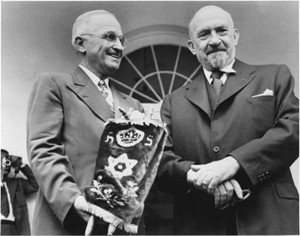
And when Israel’s chief rabbi, Yitzchak Herzog, visiting the White House in 1949, told Truman, “God put you in your mother’s womb so you would be the instrument to bring the rebirth of Israel after two thousand years,” the president burst into tears.

Israel’s founders had a profound knowledge of the Bible, and of the modern state’s place in Jewish history. The contrast to today’s Israel is striking, if not somewhat depressing.

One can only wonder how the Olmert government perceives the glorious struggle for independence and statehood, and how it explains away the jarring contrast of that generation’s decisiveness and accomplishments with its own inadequacies.

Those officials who have boasted about how “tired” the people of Israel are; who have carried out the destruction of Jewish homes and communities and the internal exile of thousands of Jews and are currently plotting future retreats and expulsions; who botched a war and squandered Jewish lives and treasure; who lack a coherent strategy to deal with looming threats and improvise (poorly, at that) in response to each of the enemies’ maneuvers; who have dissipated the justification for Israel’s existence by embracing the enemy’s narrative and conceding that the land of Israel is not inherently Jewish; who shamelessly cling to power through a combination of schemes, spoils and bribes – those officials must cringe at any comparison with even the flawed giants of Israel’s founding.

We look poignantly, even enviously, on that generation – on Truman, on Ben-Gurion, and also on Menachem Begin, who tenaciously spearheaded the underground that enervated the British and hastened their departure and Israel’s establishment.

The mediocrity of today’s leadership underscores the greatness of those who sixty years ago changed our world for the better.

But such greatness, we pray, lurks within our Jewish leaders of tomorrow. Israel’s 60th anniversary is most meaningful if we internalize the spirit of 1948 – the benevolence of our Creator, the justice of our cause, the magnitude of our choices, and the awesome responsibility thrust upon those who move Israel’s destiny forward.

Then, the majestic moment of the Jewish people’s reentry into the world of nations – as overseers and landlords of their own independent, sovereign country – will continue to inspire us to build the Israel of tomorrow, the homeland of all Jews and the foundation of God’s kingdom on earth.

Rabbi Steven Pruzansky is the spiritual leader of Congregation Bnai Yeshurun, of Teaneck, New Jersey, and the author of “A Prophet for Today: Contemporary Lessons from the Book of Yehoshua” (Gefen Books) and the forthcoming “Judges for our Time: Contemporary Lessons from the Book of Shoftim.”

Words Dishearten, Demoralize – And Kill – Jewish Press 4/19/2008

ITEM: The Jerusalem Post (March 10) vividly recounted the heroism of Capt. David Shapira, a former student at Mercaz HaRav, who, hearing gunfire at the yeshiva during the recent terrorist atrocity, grabbed his weapon, left his nearby home, and ran to the rescue of Jewish children:

“At the entrance to the yeshiva in the capital’s Kiryat Moshe neighborhood, Shapira ran into a group of police officers who were standing outside the building, listening to the gunshots from inside. They warned him not to go in, but Shapira pushed them aside and entered. The officer tracked the terrorist to the library, and shot 16 bullets at the terrorist, immediately neutralizing him.”
Were Jewish police officers actually “standing outside the building” while Jewish children inside were being methodically, systematically murdered?

ITEM: The next day, the Post reported Israel had apparently agreed to an Egyptian initiative of a 30-day “period of calm” in which Jerusalem would cease “ground and air attacks in the Gaza Strip and refrain from retaliating for the terror attack at Mercaz HaRav.”
Undoubtedly, this will enable the enemy to smuggle in more and deadlier weapons as it prepares for the next round of hostilities against a nation that apparently will not defend itself or its citizens.
PERSONAL ITEM: On March 11, while driving home on Route 443 (the popular Modiin-Jerusalem highway), my sister and brother-in-law’s car was stoned by Arabs less than a kilometer from the Atarot checkpoint and within sight of an army base. Within minutes, more than a dozen cars arrived, stoned like theirs, with shattered headlights, broken windshields and dented hoods. Police and army personnel, duly informed of the danger lurking within walking distance of their location, told their fellow citizens that because the Arab assailants were standing behind the security fence, there was nothing they could do about it.
Words kill, dishearten and eventually demoralize decent, law-abiding people who are proud to live in a Jewish state. Words maim and injure – but in real time, when uttered by policemen, by soldiers, by politicians to their citizens that they will not be defended, that their lives are expendable, that their personal safety is not a priority. And words demoralize.
Had American naval hero John Paul Jones declared to the attacking British in 1779 “I will not begin to fight”; had Winston Churchill stood in the House of Commons in 1940 and proclaimed “We shall not fight in the fields nor in the streets, we shall not fight in the hills; we shall surrender”; had Douglas MacArthur left Bataan in 1942 with the stirring words “I shall not return,” they would all be – justly – disreputable figures, scorned by their nations and forgotten by history. The battles they fought would have been lost.
But such is the dispirited and dysfunctional leadership provided by the Olmert government and its immediate predecessors to the people of Israel today – a relentless message of defeatism, hopelessness, vulnerability and despair.
In the current issue of Azure (Winter 2008), Assaf Sagiv lamented modern Israel’s peculiar inversion of normative security policy. Usually, a nation risks its soldiers’ lives in order to protect its civilian population. That is why nations maintain armies to secure their borders and police departments to keep order in their cities. But in Israel today, the civilian population – in Sderot, Ashkelon, and elsewhere – is left in jeopardy in order not to risk the lives of the soldiers in combat. It is worse than unprecedented; it is a policy that crosses the line separating the simply bizarre from the truly inexplicable.
Certainly no sane person wishes for a war that will cost lives, but no sensible nation (that is, a nation that does not have a death wish) allows its civilians to be the constant targets of rockets, missiles, bombs and bullets without an effective response, in order to protect its soldiers from carrying out the missions for which they were drafted and trained.
Such pusillanimity – combined with Israel’s adoption of the enemy’s narrative that any military response is “disproportionate” and that every attack kills “innocent civilians” – only emboldens the enemy and eviscerates whatever feeble deterrence Israel still has.
Is it possible the Olmert government is laying the foundation for future horrific concessions on the grounds that Israel’s weak security posture leaves it no choice but to cut the best deal with the surging enemy and hope for the best? Sadly, it is, and would explain as well why Israel – alone among the countries of the world – cannot seem to say “no” to Secretary of State Rice. It is a nifty two-step, of asking to be pressured and then “caving in” to the pressure, but also fecklessness of an unimaginable magnitude.
Worse, Olmert’s constantly discouraging words completely underestimate the resilience, faith and courage of the Israeli people and its security forces. They endanger the lives of every man, woman and child in Israel, every resident and every tourist who walks its streets and travels its roads.
Islamic fundamentalism – the modern incarnation of Amalek – will not disappear as a result of wishful thinking and wild fantasies. While the Jews of Shushan were perplexed and bewildered upon learning of Haman’s nefarious scheme, their leaders Mordechai and Esther – Torah Jews and thinking people – formulated a plan of action to turn the tide, transform the situation and take the war to the enemy. They did not sit back passively bemoaning their fate, pleading weakness or making empty threats with blustery words that are mocked by the enemy (words that ultimately kill innocent Jews). And their efforts were rewarded with the intervention of the divine hashgacha that effected the salvation of the Jewish people and the annihilation of our foes.
The Jewish people will always respond to a leadership that instills in us faith and fortitude based on the wisdom of Torah, the imperatives of Jewish history and the call of Jewish destiny. Such leadership is sorely lacking today. Instead, Israel’s current band of incompetents has already led the country into one failed war and is incapable of planning for and successfully waging the next. Their speeches are clueless and their policies are incoherent.

Those are the real words that kill, and when that vacuous rhetoric is replaced by a truly Jewish leadership of ideas, substance and strength we will merit a revolution of Jewish life and fortune, triumph over the Amalek of our day and salvation as in the days of yore.

Rabbi Steven Pruzansky is spiritual leader of Congregation Bnai Yeshurun in Teaneck, New Jersey.

The Truth About RCA Geirus – Jewish Press – 3/12/2008

 There is a sign hanging in my office that should be standard in the office of every rabbi, communal leader, worker for Klal Yisrael or activist of any sort. It reads: “For every action there is an equal and opposite criticism.” And so goes the overheated, misleading, and at times blatantly false reaction by several of my distinguished RCA colleagues to the RCA’s recent promulgation of the Geirus Policies and Standards (GPS).

Let us sort through the myths and the facts.

         Myth: The Jewish Week headlined its report “RCA Seen as Caving in on Conversions”  (to the Chief Rabbinate of Israel). That headline is a contemptible untruth. Having served from its inception on the GPS Committee that formulated the standards, I can state that the reality is the Rabbanut never once suggested an approach to conversion in America, a change in any of our standards, or the adoption of any of their standards.
 
         Myth: The GPS calls for the re-evaluation of all conversions done in the past by RCA rabbis. This is an especially despicable falsehood, as it serves only to make generations of converts in the Jewish community anxious about their status and acceptance in the community at large. The reality is that not one past geirus is being reviewed by the RCA or its Beth Din of America, and such was never contemplated. To even suggest otherwise is to blatantly violate the Torah’s numerous admonitions against tormenting the ger.
       Myth: The RCA is shifting “to the right” (whatever that means) and has now adopted a series of harsh and restrictive regulations that will hinder the ability of non-Jews to convert. The reality is that these standards are not new, but an expression of the majority opinion in halacha as interpreted through the ages and historically applied by the overwhelming majority of RCA rabbis involved in geirus.
 
         The proximate cause of the promulgation of the GPS was the sense – here and in Israel – that some rabbis, both inside and outside the RCA, were not adhering to any reasonable benchmark by which geirus has traditionally been executed. This situation had to be rectified in order to protect the integrity of geirus in America and to facilitate a convert’s acceptance in Israel should he or she choose to make aliyah.
 
         Myth: The Chief Rabbinate will sit in judgment of each American geirus – past, present and future. Well, there is a kernel of truth in every bushel of lies. But this point is nothing new. Certainly the Rabbanut has no standing (or interest) to review the geirus that occurs outside Israel until and unless there is some Israel nexus, such as when the convert makes aliyah. But this has always been the case.
 
         As a pulpit rabbi, I have provided dozens of affidavits to the Rabbanut attesting to the Jewishness of my members who were born Jews or who converted according to halacha andwho wished to make aliyah or marry in Israel. And this is justly the province and domain of the Chief Rabbinate, and its legal authority under Israeli law. In this instance, the GPS makes the process easier, as participating regional batei din in the network of the RCA, under the auspices of the Beth Din of America, are pre-certified to have their conversions accepted by the Rabbanut.
 
         A convert who (sadly) never contemplates aliyah or does not marry in the State of Israel will never have any contact with the Rabbanut on these matters.
 
         Myth: The Chief Rabbinate will not recognize any conversion performed outside the GPS framework. This is also completely false. Any rabbi – RCA or otherwise – can continue to perform conversions on his own and apply to the Rabbanut for acceptance. The considerations the Rabbanut will use are its alone, and completely within its purview. I suspect that some conversions will be accepted, and others rejected – as it has always been.
 
         Beyond the myths, there is a bigger picture that needs to be considered. One of the most joyous moments in the rabbinate, for me, has been presiding over the conversion process. In a single instant, a non-Jew accepts upon himself not only the laws and customs that regulate Jewish life but also the history and destiny of our covenantal people. A conversion properly conducted and performed is fraught with solemnity, consequence and elation. The process should require intense study, a steadily increasing commitment to halachic practice, and climaxing in a complete acceptance of the mitzvos while standing in the mikveh.
 
         Nevertheless, it has long been an open secret in the United States (filtered over time to rabbinic authorities in Israel) that there were some American rabbis – again, both members and non-members of the RCA – who officiated at conversions that lacked these prerequisites. Apparently there were rabbis who took substantial sums of money for conversions, turning this sublime process into a lucrative business. There were rabbis who were forced to convert non-Jews under duress, as in the (hypothetical) shul president stating: “Convert my future daughter-in-law or find another job.”
 
         There were rabbis who were lax in applying the appropriate halachic standards and not insisting, expecting or even contemplating that there would be kabbalas hamitzvos in any realistic way – conversions without a genuine commitment to observance of Shabbos, kashrus, taharas hamishpacha and other staples of Jewish life.
 
         They asked questions with a wink and received the appropriate answers by the candidates, as if they were reading from a script. (And in almost every such case the conversions were performed for the purpose of marriage. Why else would a rabbi even think of converting a non-Jew who does not wish to observe Jewish law, except for some pressing ulterior concern that itself undermines the very fabric of geirus?)
 
         There were rabbis who were negligent even in the technical performance of the act of geirus, including a failure to observe the immersion in the mikveh. There were rabbis who converted non-Jewish women knowing they would marry kohanim in violation of Torah law. There were some who availed themselves of every leniency and loophole, ensuring that pro forma conversions would take place that would satisfy the needs of the member in question but not necessarily the letter or spirit of the law.
 
         (Lest the reader think there was pervasive chaos, the “rabbis” referred to in the examples above were usually the very same small number of people.)
 
         The GPS Committee performed a vital public service in formulating and disseminating these standards. The formation of regional batei din across the United States – and the ban on the sponsoring or teaching rabbi from serving as a dayan for someone he himself taught or guided – ensure that the individual rabbi is shielded from undue pressure to perform a conversion that is unsatisfactory and lacking in halachic substance.
 
         These dozen batei din, and the more than forty rabbanim who serve on them, have the full backing of the Chief Rabbinate, ensuring that converts who are potential olim receive a royal welcome home. And, I suspect, the existence of these batei din will sharply reduce the number of non-Jews who convert solely for marriage or some other inducement. Further, the GPS deals sensitively with gerim who are contemplating marriage but wish to convert sincerely, with intermarried couples that want to re-enter the community of committed Jews, and with infertile couples who wish to adopt a non-Jewish child and confer merit upon him under the wings of the Divine Presence.
 
         With all due respect, I must strongly object to my colleagues’ demagoguery, which serves only to alarm true and sincere converts as well as promote these esteemed rabbis’ own private, political agenda. The GPS Committee – comprised of a geographic and hashkaficcross-section of the RCA – labored over 18 months to produce an appropriate formula that universalizes standards for geirus but that nonetheless allows for the flexibility needed in evaluating something as subjective as another person’s commitment and sincerity. It has, perhaps, the support of 97% of the RCA membership. It is fair, honorable, sensitive, just and moral.
 
         Its opponents, rather than talk in flowery generalities, must answer the following:
 
         Do you require from prospective converts a genuine commitment to observance of Shabbos, kashrus, and other fundamental areas of Jewish law? If not, please state so openly.
 
         Do you perform conversions in which there is willful blindness to reality in order to accommodate those whose commitment is lacking, and have you ever officiated at a conversion in which you were doubtful of the candidate’s sincere commitment to Torah and mitzvos? If so, please state so openly.
 
         Do you feel you are performing a public service in adding to the ranks of the Jewish people those who do not share our value system, our lifestyle or our destiny – thereby transforming good and decent non-Jews into sinning Jews? If so, please state precisely the nature of that public service, explain the reasoning behind that disservice to non-Jews as well as the justification that underlies the unbridled attack on the sincere efforts of your colleagues.
 

         Certainly, for every action there is an equal and opposite criticism – if only the criticism would be reasonable, measured, truthful and justified.

 
         With the GPS system in place, a stumbling block has been removed from the process of conversion and the process itself simplified; the honor of righteous converts has been redeemed; the privilege of joining the Jewish people given its proper credence; and, most important, the Torah has been magnified and glorified.
 

         Rabbi Steven Pruzansky is spiritual leader of Congregation Bnai Yeshurun in Teaneck, New Jersey, treasurer of the Rabbinical Council of America, a member of the Geirus Policies and Standards Committee, and the rosh beit din of the Beit Din L’Giyur in Bergen County where, he reports, GPS guidelines are already in place and functioning superbly.

A Glimpse Into The Mindset Of A Judicial Oligarch – Jewish Press – 12/27/2007

“A democracy must fight terror with one hand tied behind its back.”

       So stated Aharon Barak, the former president of Israel’s Supreme Court at a forum I recently attended at the Shasha Center for Strategic Studies at the Mount Scopus campus of Hebrew University.
 
      The discussion centered on the potential and real conflict between democracy and the war on terror, and featured a debate between Barak and Judge Richard Posner, former chief judge of the United States Seventh Circuit Court of Appeals (based in Chicago), and one of the leading conservative legal scholars in the United States.
 
      Abstractions do not always mingle well with the real world. Hebrew University President Menachem Magidor bragged that it is good to be in an ivory tower, detached from the real world and capable of pontificating about anything without consequences, although, he said, “we should keep the doors and windows open to see what the people are doing.”  
 
      So when the evening began with 25 minutes of heckling from individuals protesting “the occupation,” the liberal authorities (and HU is a liberal bastion) had no idea how to respond. People jeered – at the evening’s chair, former Mossad head Ephraim Halevy, and then at Barak when he started to speak – and security raced over to plead with the protesters to sit down and be quiet, and plead, and plead some more.
 
      I was sitting in the third row with a group of professors (don’t ask), and when one said, “See, this is real democracy,” I answered, “No, this is not democracy, this is anarchy.”
 
      After 20 minutes the crowd started chanting to throw the hecklers out, and eventually the ringleader was dragged away (howling that her rights of free speech were being violated!). Five minutes after she left, another one started in. By the fifth such demonstrator, “tolerance” was tossed to the wind, along with the remaining protesters.
 
      The irony is that they should have stayed, because Barak’s words, actions and philosophy are powerful weapons in the hands of terrorists and a major reason why Israel’s strategic position has declined so precipitously in the last 15 years.
 
      Justice Barak posited that the main function of a judge in the war on terror is to protect democracy “both from the terrorists and from the means the state uses to combat terrorists.”
 
      The judge protects democracy from the state, the Knesset, the army, and even the people – even if there is less security for the people. Any curtailment of liberties that occurs in wartime will inevitably carry over to peacetime, and, in any event, “peace for one person is war for another.” Terrorists are just “lawbreakers” and must be dealt with, but not at the expense of fairness, justice or their human rights.
 
      Thus, he boasted of his court’s decisions (almost all written by him) forcing the army to re-route the security wall (“the additional security provided was not commensurate with the additional harm caused to Palestinians”); overturning the government’s decisions expelling certain terrorists; nullifying the Knesset’s law permitting the demolition of the homes of terrorists; and setting the standards on a case-by-case basis for targeted assassinations of terrorist chieftains.
 
      Barak even invalidated the Knesset’s repeal of the “Family Reunification Law” that had permitted Israeli Arabs to marry spouses from Judea, Samaria and Gaza and enable them move to Israel proper. This law became, in effect, an underground railroad for terrorists as no fewer than 26 of these “spouses” were subsequently imprisoned for perpetrating murderous acts against Jews. Barak ruled that the law must remain in effect, as it would violate the human rights of Arabs not to be able to choose their spouses and have them live in Israel. (Of course, the women could have moved to the Gaza paradise to live with their basherts, but Barak did not consider that.)
 
      And so on. Barak prided himself on ruling Knesset laws unconstitutional, a neat trick given that Israel has no written constitution. He paid lip service to Justice Robert Jackson’s famous dictum that “the Constitution is not a suicide pact” and to the idea that a government’s primary obligation is to protect its citizens. But Barak sees a higher value – protecting the abstract beauty of democracy and human rights (in which “judges are the experts”), notwithstanding the harm to the individual.
 
      The altar of democracy requires sacrifices. Of course, Barak likely does not ride buses, or shop in Machane Yehuda, or have any relatives in Sderot. Nor, strange as it sounds, did Barak even mention once that Israel is a Jewish state. Democracy uber alles.
 
      Imagine if the ACLU actually governed the United States instead of just incessantly filing lawsuits; that is the picture of the legal system in Israel today. It is both naïve and dangerous.
 
      I was reminded of George Orwell’s observation that “some ideas are so absurd only an intellectual could believe them.” But Judge Posner, who is as soft-spoken as he is brilliant and riveting, demolished Barak’s arguments point by point. Clearly from the American experience, he said, there is no slippery slope.
 
      In every war (beginning with Lincoln’s suspension of habeus corpus during the Civil War), there were severe limitations on various civil rights, but when the war ended the measures were simply repealed and the status quo ante restored. Many of the restrictions imposed after the Arab Terror of 9/11 have already been relaxed (foolishly, Posner thought).
 
      It is unthinkable in an American context that the Supreme Court should insert itself at will into the decisions of the political or military establishment, and micromanage government and security. Cases take years to get to the Supreme Court, so American judges already have real-life experience as to what works, what doesn’t work and what real harm is caused, if any.
 
      Judicial tyranny is also incompatible with democracy, and judges are not omnipotent, Posner said. (Much of the audience cheered, and Barak squirmed.) He lambasted Barak’s assertion that Barak’s decisions are (as Barak had said) the “correct interpretation of law”, and said he – Posner – would never say that he is indisputably correct even when he is in the majority.
 
      Posner added that he never uses terms like “justice, fairness, human rights,” deriding them as “empty words” that can be twisted by a judge to mean whatever he wants them to mean. And then there is no “rule of law,” but the subjective opinion of one person who is no more informed or expert in these nebulous matters than any other person.
 
      Law is a “river of uncertainty” and it is perilous when judges create an “air of mystery” around their decisions, as if they are descending from some higher authority. He quipped that sometimes “with freedom comes irresponsibility.” But, he asserted, in America “we don’t want to fight a war with one hand tied behind our back.” American courts are not unfettered; Congress can limit their jurisdiction and budgets. And judges should never feel completely independent; “judicial independence is not a synonym for omnipotence or the rule of judges.”
 
      Interesting, a Jew with seichel. Democracy is based on majority rule with protection for minority rights – but the minority does not have the right to infringe on the lives and well-being of the majority.
 
      Barak was left to grimace, and then – in rebuttal – to remark how disappointed he was in Posner’s “extreme” views. He went on and on and on about the indispensability of unlimited judicial power as the only safeguard for democracy and human rights. “There is no justice without fairness, and there is no democracy without human rights,” he declared.
 
      At that point, a gentleman in the third row asked: “What about the settlers from Gush Katif? Did they have human rights, or do human rights only flow in one direction, to Arabs?” The audience was thrust into silence and then a low murmur at this most peculiar turn of events – a pro-Jewish advocate at Hebrew University. (All right, I confess, the inquirer was me. I had more to say but held back so as not to be rude.)
 
      Barak was flummoxed. He looked at me and could not respond except for mumbling some platitude about the right to free speech. He ended his talk abruptly and sat down. Posner, who was sort of beaming during my brief remarks, had the decency not to respond to Barak’s condescension to him, and the evening ended.
 
      In an instant, the bubble of high-minded, self-righteous piety had been burst, and the emperor was shown to indeed have no clothes. In the world according to Barak, it is an outrageous and unacceptable affront to justice to demolish the homes of terrorists – murderers of Jews – but perfectly acceptable and moral to demolish the homes of 9,000 religious-nationalist Jews.
 
      The dangers of subjectivity in law – by a self-perpetuating judicial oligarchy answerable to no one, composed exclusively of like-minded liberals who are charged with appointing their successors – became apparent. It was now easy to understand how Jewish teenagers who had blocked a highway to protest the Gaza expulsion could be sentenced to two years in prison.
 
      I left and walked to Mount Scopus to gaze at the Temple Mount, thinking of the lyrics of Yehoram Gaon’s famous song about Jerusalem: “For a hundred generations, I dreamt of you – to cry, to see to merit, the light of your face.” That light, of course, is the light of the Torah that goes forth from Zion and that does not yet have any standing before Israel’s judges.
 

      I then drove to the Kotel as the Tenth of Tevet began – to be cleansed, to be comforted, to daven Maariv, to mourn the thousands of victims of Barak-ism, and to pray that Israel survive even the well-intentioned efforts of the Knights Templar of “Democracy and Human Rights.”


      Rabbi Steven Pruzansky, the spiritual leader of Congregation Bnai Yeshurun in Teaneck, New Jersey, is currently on Sabbatical in Israel.